Before I left on my trip, I liked to say that I planned to eat and drink my way across southern Europe. Gyros and souvlaki in Greece, topped off with ouzo; pasta and wine in Italy; tapas in Spain. Eating in small cafes, owned by a local. Rick Steves (What! You haven’t heard of Rick Steves, the guru of independent travel in Europe?) says that if the restaurant menu is in English and has fancy pictures, you’re in the wrong place. The food will be better and cheaper if the menu is in the local language, preferably hand-written, with only a handful of menu options, based on local, in-season ingredients.
Sounds like my kind of place! At least from my armchair in Rosthern. It feels a little different on the street here. In Greece I can’t even guess what the items are, written in their indecipherable (to my unlearned eye) script. Am I ordering something to drink or is it the main course? I scan the cluster of tables, crowded together, with friends and families laughing and talking. And feel very intimidated!
It’s not just the language barrier. It’s the procedure. Do I sit down and wait for a server? Do I go to the counter and order? Do I pay first or do I wait for a bill? In Australia it seemed like you always ordered at the counter and paid and then found a seat and they brought the food to you. In Europe, you generally sit at the table, even in places that look like it’s counter service only, and a waiter comes to take your order. Except in some coffee shops where you order at the counter, get your food, then sit at a table and pay before you leave. And in Italy, at bakeries, you tell the people behind the counter what you want, they give you a ticket, you take it to the cashier and pay for it, then take your receipt back to the counter to get your order. It can be very confusing, but you learn that it’s okay to make mistakes. Don’t take yourself too seriously and laugh at your ignorance!
Then there’s the timing of what to eat and when. In Athens I went out one morning about 7 looking for breakfast. I was quite hungry, having been awake since 2 AM. It was when I had just arrived and my body was still trying to figure out what time it was. I had woken up about 2, composing a blog post in my head. 3 o’clock and I was still composing. So I decided to just get up and write it down and then I would be able to sleep. Isn’t that what great writers do? Seize the moment!?! Well, it didn’t work that way. I still couldn’t sleep. So I went out. Wandering around Athens, looking for a breakfast restaurant, with the locals rushing past me with their espresso and pastry in hand, I realized that Greeks, at least Athenians, don’t eat a sit-down breakfast. They’re in a hurry to get to work, sleeping in until the last minute as they were out late the night before, eating dinner at 10 or 11 PM.
But back to my morning in Athens, I finally stop to buy a thin, sesame-coated pretzel and eat as I walk down the street. Delicious! But I’m still hungry. As I walk by a cafe with tables out front and a sandwich board that promises breakfast (in English) , a young man greets me and invites me in to the cafe. There are no other customers in the restaurant. Several people are busy behind the counter. They have a breakfast menu. In English. With pictures. Screw Rick Steves and my high ideals. I will order an omelette.
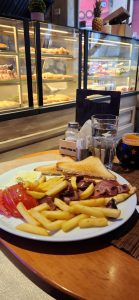
This is what I got. It didn’t look like the picture in the menu and the omelette was quite mediocre. The whole time I sat there, deliveries were being made by suppliers. Big jugs of olive oil, vegetables, meat, cheese, bakery items. I think the main reason they were open was to receive deliveries. And if they could snag a foreigner walking by, that was a bonus. But it was very entertaining and it did fill the void.
Timing continues to be my main problem with finding food to eat. That and my unwillingness to eat standing up. Greeks eat while they’re walking. Italians can’t do that as they need one hand free in order to talk. They tend to stand at the counter to eat and drink. But timing! I rather like eating my main meal between 2 and 4, which is common here, but I can’t seem to get my body to adjust to eating dinner at 10.
My last night in Bari (actually my only night as I, unfortunately, booked my onward journey to Rome, panicking when my hotel options seemed to be disappearing as I waited to decide what to do next), I went out about 8PM looking for a pasta place so that I could taste their famous pasta, orecchiette. All of the street cafes were filled with people drinking espresso. There were a few pizza restaurants filled with tourists. Some restaurants have figured out how to double their revenue. Open from 6 to 9 for tourists, then have another sitting for locals from 10 to midnight. I finally found a fast food place with displays of all their food. I ordered, paid, and was given a little puck-sized disk at my table. In about 5 minutes, lights on the disk started flashing. My order was ready! I took the disk to the counter and got my food. It wasn’t bad, but certainly not exceptional.
In Rome I booked a food tour with Devour. This is an excerpt from their website:
We crave food and travel experiences with a true sense of place.
It all began at a traditional market in the center of historic Madrid. The first Devour Tour was a deep dive into Madrid’s vibrant food culture and a way to support the city’s struggling mom and pop shops.In the height of the economic recession, founder Lauren Aloise was saddened by the struggling local market, where half of the stalls were shuttered. Her first tours highlighted the difficulties of keeping small businesses relevant in a quickly changing Madrid.
By visiting and befriending local stallholders, Lauren’s first Devourers saw a different side to the city. And our tour partners were just as eager to share their stories and expertise with curious guests.
As our tours have expanded—from walking wine tastings in Rome to flamenco feasts in Seville—the heart and soul has always stayed the same. We want to help local culture thrive, no matter where we are.
https://devourtours.com/destinations/italy/rome/
I thought that sounded pretty good. I know a lot of smaller businesses struggle while the larger restaurants attract the tourists. And it turned out great. We tasted various local, “natural” wines, had appetizers that were made from local ingredients, had three incredible pasta dishes, and finished with gelato. A couple that was on the tour were colleagues of the guide – they work in Barcelona – so I’m hoping to book a tour in Barcelona when I go through there.
One of the most difficult meals for me to adjust to is breakfast. I want some fruit and granola. Some bacon and eggs. The coffee and croissants here are incredible. But then I still want breakfast! So I’ll try to eat like a local and support the small cafes, but when I see the sign “American breakfast,” I may just slip inside, point to the picture of the meal that I want, and eat the way I want to.
3 Replies to “Eating like a Local”
Since food is one of the main ingredients of culture it makes sense to be exploring traditional eating. It does sound like it has been tricky but full of rewards. You might be on a whole new schedule by the time you return home!
I love how you travel. I’m off to Loreto tomorrow for a whale watching expedition (weather permitting) .
We’ll have to join up some time. . . I’m pretty flexible.